THE TUDOR TEA ROOMS:
A QUICK LOOK AROUND THE TUDOR TEA ROOMS, WHITSTABLE. IN THE LAST FIFTEEN YEARS OF PETER'S LIFE MOST DAYS HE WOULD TAKE THE SHORT WALK TO HIS FAVOURITE HAUNT FOR HIS LUNCH.
HE ALWAYS SAT AT HIS RESERVED TABLE, WHERE TODAY A FRAMED PHOTOGRAPH AND PLAQUE BEARING THE INSCRIPTION: 'IN LOVING MEMORY OF OUR DEAR PETER CUSHING. A SADLY MISSED FAMILY FRIEND'
Saturday 25 February 2012

Friday 24 February 2012
OUR FIRST WINNER! HAMMER FRANKENSTEIN FRIDAYS COMPETITIONS EVERY FORTNIGHT!

OUR FIRST WINNER! Here's a snap of our first winner in our fortnightly Horror Unlimited / Hammer Frankenstein Fridays Competitions! Colin Beardmore poses proudly here with his prize. A terrific still from Hammer Films 'Frankenstein and the Monster from Hell'.
'Having been the lucky winner and recipient of the competition at The UK Peter Cushing Appreciation, a few words to endorse what a... lovely surprise and what a fantastic photograph of Shane Briant and Peter Cushing from Frankenstein And The Monster From Hell . It is remarkably reproduced and I seen nothing like this before . Clear imagery which looks like 3 D! Especially the plate of brains in the photograph . Thank you to Marcus for a wonderful gift and for the opportunity to own it . Greatly appreciated!' Colin Beardmore.
We be announcing the WINNER TONIGHT of LAST WEEKS COMPETITION here at petercushing.org.uk. theblackboxclub.com and theukpetercushingappreciationsociety FACEBOOK PAGE.
Tuesday 21 February 2012
PETER CUSHING: 'TORTURE GARDEN' SOWING THE SEEDS! PROMOTION GIMMICKS!


THE TRAILER FOR AMICUS FILM PRODUCTIONS 'TORTURE GARDEN' IN 1967. A TIME WHEN CINEMA WAS FUN AND GIMMICKS TO PUT 'BOTTOMS ON SEATS' WAS PART OF THE GAME. HERE THE PAYING PUBLIC WERE PROMISED A PACKET OF 'SEEDS' TO GROW THEIR OWN 'TORTURE GARDEN'!
PETER CUSHING JACK PALANCE: 'TORTURE GARDEN' REVIEW AND GALLERY

PRODUCTION TEAM:
Director: Freddie Francis. Screenplay: Robert Bloch, Based on his Short Stories. Producers: Max J. Rosenberg & Milton Subotsky. Photography: Norman Warwick. Music: Don Banks & James Bernard. Makeup: Jill Carpenter. Art Direction: Don Mingaye & Scott Simon. Production Company: Amicus film Productions.

CAST:
Burgess Meredith : Dr Diablo. Enoch:- Michael Bryant: Colin Williams. Maurice Denham: Uncle Roger. Terror Over Hollywood:- Beverly Adams: Carla Hayes. Robert Hutton: Bruce Benton. John Phillips: Eddie Storm. David Bauer: Mike Charles. Bernard Kay: Dr Helm. Mr Steinway:- Barbara Ewing: Dorothy Endicott. John Standing: Leo. The Man Who Collected Poe:- Jack Palance: Ronald Wyatt. Peter Cushing: Lancelot Canning.
THE PLOT:
At a carnival exhibit, Dr Diablo takes five customers to a back room where he offers them glimpses of their futures. Enoch:- Colin Williams goes to stay with his uncle, determined to get hold of his fortune. He withholds his uncle’s medicine to force him to tell him where the money is, but instead the uncle dies. Afterwards, Colin meets a cat Balthazar that talks to him and demands that he conduct other killings in return for which it will show him where the fortune is. Terror Over Hollywood:- Aspiring actress Carla Hayes determinedly pursues a part in a film. Cast, she soon finds herself falling for her leading man, the enduring star Bruce Benton. But then she finds the secret of movie stars youthful longevity – that they are being replaced by robot doubles. Mr Steinway:- Journalist Dorothy Endicott goes to interview the introverted concert pianist Leo. They become romantically involved but when she tries to draw Leo away from his beloved grand piano Utopie, it becomes jealous. The Man Who Collected Poe:- Ronald Wyatt, a dedicated Edgar Allan Poe collector, goes to visit Lancelot Canning, one of the foremost Poe collectors in the world. Getting drunk, Canning shows him his secret collection of unpublished Poe works. Wyatt then makes the shocking discovery that Canning has brought Poe back to life to write new stories.

COMMENTARY:
Amicus Films had had great success with the portmanteau anthology Dr Terror’s House of Horrors (1964). They returned with Torture Garden, reuniting director Freddie Francis and star Peter Cushing. Burgess Meredith, in an appallingly fake-looking beard, is clearly cast in the same mold as Peter Cushing’s Dr Schreck in Dr Terror, as a sinister figure introducing the segments on the pretext of showing people their future. On script, Amicus imported American horror author Robert Bloch who was then in the public eye as a result of Alfred Hitchcock’s wildly successful adaptation of his novel Psycho (1960). For Torture Garden, Robert Bloch adapted several of his own short stories published in the 1950s into a script. Bloch later went on to become a mainstay of Amicus, contributing to several other anthologies such as The House That Dripped Blood (1970) and Asylum (1972) and original films like The Skull (1965), The Psychopath (1966) and The Deadly Bees (1967).

Torture Garden is one of the lesser among Amicus’s mostly worthwhile anthologies. The first two stories are flat, Terror Over Hollywood being the especially weak link in the chain. But the next two are sharp and original – compare them to Dr Terror’s humdrum revamping of standard B-movie themes and it becomes clear just what Bloch manages to bring to the party. Freddie Francis brings his customary stylism and sharp pictorial contrasts between fore– and background. Memorable images abound such as Barbara Ewing being chased about the house by a grand piano. The Edgar Allan Poe segment works the best where Jack Palance and Peter Cushing are clearly enjoying themselves. The linking segment is slight. One might also note that, despite the title, the film features no torture, nor any gardens. For that matter, despite the title Terror Over Hollywood, the segment is actually set in an English studio. Much better anthologies would emerge from Amicus – see Tales from the Crypt (1972), From Beyond the Grave (1973) and the aforementioned Bloch titles.


Review: Richard Scheib
Images: Marcus Brooks
Sunday 19 February 2012

Saturday 18 February 2012
PETER CUSHING AND THE RETURN OF THE CYBERNAUTS: THE AVENGERS TV SERIES

50 years ago the very first episode of The Avengers was transmitted. Hot Snow, shown on the 7 December 1961 and introducing Ian Hendry as Dr. Keel and Patrick Macnee as John Steed, doesn't really give much of an indication as to how The Avengers would become the ultimate expression of Sixties pop culture and a global television phenomenon.
Those early episodes are gritty, hard-nosed thrillers and I've already covered Optimum's DVD box set releases of Series Three and Series Four back in 2010 and 2009, charting how this black and white thriller blossomed as the decade moved on, and how, as James Chapman noted in his essay in Windows on the Sixties, "The Avengers both defines and is defined by the 1960s [and reflects] the social changes taking place in Britain during the period" and is a barometer of the "the technological changes that occurred in the television industry moving from 'live' performance to film, and from black-and-white to colour."And with Series 5 we do indeed move into colour, heralded with a caption card 'The Avengers in Color' on each episode as required by the American network ABC who had paid the then-unheard of sum of $2 million for the first 26 episodes and made the series one of the first, if not the first, British series to be aired on prime time U.S. television.

Series 5 takes the fantasy elements prominent in the first Rigg series and exaggerates them with the use of full colour, high-fashion elements (including costumes for Rigg and Macnee designed by Alun Hughes and Pierre Cardin), a bevvy of prominent British character actors playing a wealth of eccentrics and diabolical masterminds and a knowingness about the relationship between the television audience and the programme itself.This knowingness is present both in the number of attempts to break the fourth wall by the leading actors, with asides and direct looks down the lens, to the manipulation of artifice and surface, in set design and narratives that pull apart and glorify the very idea of making films and television programmes. It's very much Clemens and his production team emulating the progress that a director like Federico Fellini was making in his own work in the late 1960s. The Fellinesque qualities of stories such as Epic, Escape in Time and Something Nasty in the Nursery suggest a pop-art style married to increasingly metatextual narratives that comment on the art of storytelling and film-making within the contrived nature of 'Avengersland'.
'Avengersland' is a construction that Fellini would have been proud of and depicts an England of the mind, of the imagination, where increasingly during Series 5 the threats to Steed and Emma become more and more artificially generated. As I discussed in my review of Spirits of the Dead, Fellini's section of that film is about the audience understanding that Terence Stamp's character exists in a knowingly artificial world. Much the same occurs in Brian Clemens concept of The Avengers.
'Avengersland' is a construction that Fellini would have been proud of and depicts an England of the mind, of the imagination, where increasingly during Series 5 the threats to Steed and Emma become more and more artificially generated. As I discussed in my review of Spirits of the Dead, Fellini's section of that film is about the audience understanding that Terence Stamp's character exists in a knowingly artificial world. Much the same occurs in Brian Clemens concept of The Avengers.
'Avengersland' is therefore postmodernist in nature, and Christopher Sharrett, in commenting on Fellini's work from Spirits of the Dead on-wards has called this effect "the sum and substance of post-modernity [where] the piling up of 'signifiers' merely creates new attractions and commodities" and where, by extension, the colour episodes of Avengerland are created "by removing [them] from all social/political/economic context."


This self-evident awareness of its own construction, of the tropes that it uses, marks out the first colour series of The Avengers and is later developed into the Thorson series. Where the previous Rigg series had been 'Britain versus the world' it is worth noting that by 1967 this had shifted to 'Britain is the world' in the colour episodes and was very much in line with London being regarded as the epicentre of the late 1960s explosion of pop, architecture, fashion and design and The Avengers own nostalgia for a non-existent version of England where the troubles of the modern world are eradicated by a desire to recreate Edwardiana via glossy Hollywood pastiche.
Science fiction and fantasy rub shoulders with the series's own comedy of manners and sense of British fair-play, epitomised in everything from the tag sequences, the 'Mrs. Peel We're Needed' introductions and the witty captions that summarise each episode to the gaggle of malcontent British scientists, astronomers, executives, aristocrats, ministers and secret agents who believe they have been treated unfairly in the rush to embrace the 'swinging sixties' modernisation of the nation.
Personally, from Series 5, I would single out:
From Venus With Love - its obsessions about alien invasion from Venus and the deadly threat of laser weapons jostle with a comedy turn from Jon Pertwee and a stylish cameo from Barbara Shelley.
Escape In Time - an utterly surreal story about a man who provides a service to criminals that allows them to escape from the authorities into any part of past history. Superb guest cameo from Peter Bowles and filled with massive chunks of gaudy, dream-like visual/physical comedy that divorces the series entirely from any reality. Looks stunning in its restored format here.
The Winged Avenger - a clever mix of thriller, comic book (the legendary Frank Bellamy supplied the comic strips for the episode) and a tongue in cheek and metatextual nod to the Adam West Batman series in Steed's showdown with the villain where he clouts him over the head with Roy Lichtenstein inspired pop-artwork declaring 'Pow!' 'Blam! and 'Splat!' Another sequence where live action flips back and forth with comic book recreations was way ahead of its time.

Never, Never Say Die - a pastiche of the Frankenstein story with a great guest performance from Christopher Lee.
Epic - stunningly restored here and a wonderfully surreal blend of Sunset Boulevard and Fellini's 8½, thoroughly divorced from realism and driven by completely glorious performances from the triumvirate of Peter Wyngarde, Kenneth Warren and Isa Miranda.
Something Nasty in the Nursery - more surreal and nightmarish imagery that twists childhood memories completely out of shape. It's a very knowing episode that allows the audience in on the artificiality of the storytelling.
Who's Who? - great fun in that it allows Macnee and Rigg to stretch and play against their characters and it features an equally sensational double-act in Freddie Jones and Patricia Haynes as the agents they swap bodies with. The ad-breaks are structured to feature a very tongue-in-cheek recap for the audiences as to who is exactly whom as the story continues.

Return of the Cybernauts - Peter Cushing is sublime as the villainous Paul Beresford, and the story is unusual in that he is actually a friend of Steed and Emma's and there are undercurrents of jealousy from Steed when Paul gets very enamoured of Emma.
Dead Man's Treasure - glorious romp combining a treasure hunt, a cross-country car chase that showcases the English countryside at its most beautiful, a deadly racing-car simulator and Laurie Johnson's bouncy incidental music.
The Positive-Negative Man - more surreal, comic strip inspired material successfully blended with an espionage thriller and featuring Ray McAnally at roughly the same time he went on to make the sublime Spindoe for Granada.
The quality of the image here is again very good and with many episodes it is truly sensational, with vibrant and exceptional colour and contrast that show off the gorgeous sets and location shooting and often revealing fine detail in faces and costumes.
These are blemish free digital masters, exquisitely restored but there is a noticeable shift in the quality of cinematography between the earlier and later episodes in the production run. Certainly the contrast and colour fidelity isn't as robust in The Fear Merchants for example but I would put that down to the way it was shot rather than a fault of the restoration.
The restoration is of such good quality that it simply begs for a Blu-Ray release in high definition and I hope that Optimum will be looking to achieve this in the next year as I think these will look particularly stunning in HD.
The highly effective and memorable music from Laurie Johnson is well represented on the soundtrack but alas, there does seem to be a problem with the sound mix. It is obvious that the vocal track is slightly speeded up and is particularly noticeable with male voices, especially Steed's, which are pitched slightly too high. Optimum have already been made aware of this and are offering replacement discs for this set. A real shame that problems like this are not being identified by the company's own quality control department. It's a blemish on an otherwise fantastic DVD set.
The commentary to The Winged Avenger, moderated effectively by Jaz Wiseman, covers writer Richard Harris's contribution to the original black and white series of The Avengers and the comic book influences that went into the creation of his script for the colour Rigg series. The chat is interesting and informative and very much focuses on his career as a writer, including his work on the Hancock scripts for ATV and developing Man in a Suitcase.

Perhaps the stand-out commentary on this set has to be from the legendary Peter Wyngarde on the episode Epic. Wyngarde is clearly not that concerned about remembering the more intricate details of the episode (although he dedicates it to colleagues James Hill, Isa Miranda, Kenneth Warren and Albert Fennell) but goes on to regale us with tons of anecdotes about his theatrical career, working with Ralph Richardson, and breaks off to put in a performance as George Sanders and later recites various songs and poems. A true 'luvvie', bless him.
Stunt artist Cyd Childs and writer/producer Brian Clemens also offer interesting stories and anecdotes on their own commentaries for, respectively, Return of the Cybernauts and Murdersville.

Once again there is a massive amount of supplementary material on the DVD set:
- Archive German TV interview with Patrick Macnee and Diana Rigg
- Episode trims from The Fear Merchants, Escape In Time, From Venus With Love and The See-Through Man
- The Avengers – A Retrospective (documentary produced for the Lumiere VHS releases)
- ATV newsreel footage (Diana Rigg receives TV Award)
- The Avengers – “They’re Back” archive trailer
- Filmed episode intros by Brian Clemens to The Bird Who Knew Too Much, The Living Dead, Epic, The Correct Way To Kill, The Superlative Seven, A Funny Thing Happened On The Way To The Station, The Joker and Murdersville
- Granada + points for each episode
- Episode Reconstructions for lost Series 1 episodes One For The Mortuary, Death on The Slipway, Tunnel of Fear and Dragonsfield
- 1960s German Titles
- Insert reprint of series 5 promotional brochure
- Stills gallery for featured episodes (literally hundreds of images)
- PDF material including shooting scripts, TV Times and more
An essential purchase but marred by that sound fault so proceed with caution and check that Optimum are still replacing the erroneous discs and replacing stock in stores.
The Avengers
Digitally Restored Special Edition: The Complete Series 5 / 1966-67
Released 25 October 2010 / Optimum Releasing / OPTD1751 / Region 2 / Cert PG / Running time: 1,127 mins / 4:3
Review: Frank Collins
Images: Marcus Brooks
VINCENT PRICE AND PETER CUSHING: PRESS BOOK MADHOUSE (1974)

GREAT EXAMPLE OF 'MADHOUSE' PROMOTION BACK IN 1974
SUSAN DENBERG, PETER CUSHING AND OTHER HAMMER FILM FACES BEHIND THE SCENES ON 'FRANKENSTEIN CREATED WOMAN' HAMMER FRANKENSTEIN FRIDAY

SUSAN DENBERG POSES WITH HER CO STAR AND
FRANKENSTEIN'S ASSISTANT THORLEY WALTERS

EVERYONE POSES FOR THE CAMERA! PETER HAS A LAUGH AT
PRODUCER ANTHONY NELSON KEYS, WEARING HIS TOP HAT!

THE TEAM: PETER CUSHING, SUSAN DENBERG, PRODUCER ANTHONY NELSON
KEYS AND DIRECTOR TERENCE FISHER POSE FOR THE CAMERA AT FRENSHAM
PONDS, THE LOCATION FOR THE GUILLOTINE SCENES IN 'FRANKENSTEIN
CREATED WOMAN'

SUSAN DENBERG AND PRODUCER ANTHONY NELSON KEYS SHELTER
UNDER A BROLLY BESIDE A PROP ROAD SIGN BEARING THE NAMES
OF TWO FAMILAUR HAMMER FILM TOWNS :
KARLSBAD AND INNSBAD.

THE BROLLY BECOMES A HANDY PROP AS BOTH PETER AND
SUSAN DENBERG TAKE A STROLL AROUND BRAY STUDIOS, HOME TO
HAMMER FILMS AND SO MANY OF THERE BEST MOTION PICTURES.

MORE POSING FOR THE STILLS MAN

NOTE THE SCRIPT UNDER PETER'S ARM IN THIS SHOT. PENS PENCILS AND
RUBBER BANDS. PETER WAS WELL KNOWN FOR HIS NOTE TAKING AND
SCRIBBLES IN THE MARGINS OF HIS SCRIPTS. POINTERS TO DIALOGUE,
REMINDERS AND ALSO DOODLINGS. PETER LOVED TO DOODLE
WHILST WAITING, SOMETIMES LONG HOURS ON A SET.

AND THE SHOOT WRAPS WITH ONE OF PETER'S SIGNATURE
KISSES TO HIS CO STAR, SUSAN DENBERG

Friday 17 February 2012
FRANKENSTEIN CREATED WOMAN: THE CLASSIC POSE AND ONE OF THE FIRST PLACES IT APPEARED!

FRANKENSTEIN CREATED WOMAN: THE CLASSIC POSE AND ONE
OF THE FIRST PLACES IT APPEARED!
Wednesday 15 February 2012
THE STORY BEHIND PETER CUSHING AND 'CORRUPTION': COMMENTARY AND GALLERY

After the end of the second world war, Robert Hartford-Davis worked in a variety of capacities at numerous British studios before making his own short films and episodes of TV shows like Police Surgeon (1960). In mid-1962 he won the contract to make films for Compton-Cameo, who ran profitable cinema clubs specialising in risqué films and now wanted to branch out into film production.
So successful were the 1963 pictures That Kind of Girl (which Hartford-Davis produced), and The Yellow Teddybears (which he produced and directed), that a year later he was appointed 'executive in charge of all production'.

Director of Photography on these films was Peter Newbrook, who had previously worked on such prestigious pictures as The Sound Barrier (1952), Lawrence of Arabia (1962) and In The Cool of the Day (1963). In August 1964, Hartford-Davis and Newbrook formed Titan Productions, immediately making the bizarre pop musical, Gonks Go Beat (1965). Their biggest budgeted film followed in 1966: The Sandwich Man was a comedy produced with money from the National Film Finance Corporation, a funding organisation set up to initiate new independent British film productions.

Not even cameos from numerous top British comic stars could prevent it from being only a modest success, and with none of the other NFK-funded films succeeding, Titan had to look elsewhere for capital. It came in January 1967 from independent American company, Oakshire Films, with whom Titan signed to make three films, all to be distributed through Columbia. The first two announced - The Mask of Innocence, a story of a child's obsessive love for her father, and We, the Guilty, concerning the nationwide pursuit of two prison escapees - both went unmade. The third was Corruption.

Hartford-Davis came up with the original idea and brought in Donald and Derek Ford to write the script. The Fords had written all of Hartford-Davis's Compton-Cameo releases, and had stayed with the company to author the classic Sherlock Holmes versus Jack the Ripper film, A Study In Scarlet (1965).
Peter Cushing was the obvious choice for the top-billed part in any British horror film. Discussing Corruption with Eamonn Andrews on television, he remarked that he was looking forward to his next picture; a horror film in modern dress, for a change.
Receiving equal billing was Sue Lloyd, who had previously appeared as Michael Caine's girlfriend in The Ipcress File (1965) and had a recurring role in The Baron (1966). Hartford-Davis would be so impressed with her work on Corruption that he'd present her with an antique cup inscribed, "To my actress of the year, from your corrupted director." At the end of shooting, Cushing presented her with a special script holder. "I did rather well out of that film!" she now laughs. Kate O'Mara, a relative newcomer to film, was cast as Lynn's sister, and Anthony Booth - then popular as Alf Garnett's son-in-law in Til Death Us Do Part (1966) - played groovy photographer Mike.

When making movies, Hartford-Davis apparently considered actor David Lodge his "lucky charm"; a part, therefore, had to be found for him. Lodge remembers: "I said, 'There's nothing in here for me.' He said, 'There's got to be something. I tell you what, what about one of the hippies?' I said, 'They're kids!' - and I was well into my forties. He said, 'We'll make one of them a big idiot with the mental age of about 12. He's retarded.'" So was born Groper, the strongman of Terry's beatnik gang, blindly obedient to leader Georgie.
Saving money where they could, Titan used Isleworth Studios in south-west London, not far from Hartford-Davis's home. Primarily use for making adverts in the year prior to the Corruption shoot only one other film had been made there.

The film's four-week schedule commenced on 10th July 1967, and most scenes were completed quickly. One exception was the discovery of the head in the fridge by Sandy, a female gang member. Actress Alexandra Dane was so shocked by the sight of an apparently decapitated head that she became quite distressed on the first take. The crewmen who had the job of stuffing the head with various offals referred to it as 'the laughing Japanese shot'. Far East audiences enjoyed a lot of gore, apparently.

The finale - in which the laser disposes of most of the leading characters - was achieved by stringing up lengths of wire around the set, which were then lit, and burned brightly where the laser was supposedly striking. Sue Lloyd remembers that the actors had to be wary of their positions if they were to avoid being injured.

Care also had to be taken in the scene in which Groper holds a brandy glass over Lynn's mouth in order to get information out of her. John Lodge remembers being cautious to leave a small gap so she could still take in air. Location shooting took place at Seaford, between London and Brighton. The scene where Lynn lures Terry's husband, Rik, to the edge of the cliff and forces him over was especially arduous for Sue Lloyd: "I suffer from terrible vertigo and that cliff was a sheer drop. I just couldn't do it. I just froze and in the end they had to get a double in. If you look, you never see my face when she pushes him off."

The murder in the train was also shot on location. This disturbing sequence was shot by Newbrook through a fish-eye lens, lending it a delirious quality. Another murder - that of the prostitute in the flat - was shot twice. In the version seen in Scandanavia, South America, and the Far East, a bare-breasted Marianne Morris, replacing the negligee clad Jan Waters in the regular edition, is attacked quite graphically by a manic Cushing. Again, Newbrook used a distorting fish-eye lens in the scene.

Over a year after its completion, the film premiered at London's Metropole on 21st November 1968, but was replaced after a week by Carry On Up the Khyber (1968). On general release from 8th December, Corruption was paired with an Alex Cord spaghetti western, Un minuto per pregare, un instante per morire / Dead or Alive (1968).

David Lodge recalls going to see an early screening of Corruption with Peter Cushing and them both chuckling all the way through. Cushing later remarked: "I felt it was a great idea, but the only thing I felt about the picture was that it was repetitive within itself - and it had to be, I suppose, because of what the story was about ... I think with a little more time it could have been more subtle, but even so it was an incredible success in America."

After filming ended, Peter Cushing went immediately into The Blood Beast Terror (1968) (then known as The Deathshead Vampire) at Goldhawk Studios. Sue Lloyd eventually became a regular on the television soap opera Crossroads (1964 - 1988), and later recreated her Ipcress File role in a new Harry Palmer film shot in Russia, Bullet to Beijing (1997). David Lodge continued to appear in many British films (in The Railway Children (1970), his Bandmaster can be seen wearing Groper's pebble-lensed spectacles).

After two more movies, the partnership of Hartford-Davis and Newbrook broke up. Newbrook formed Glendale Productions, responsible for both Crucible of Terror (1971) and The Asphyx (1973). Robert Hartford-Davis formed World Arts and made two further pictures in England before relocating to Hollywood for two more, and some television. In 1977, he was just starting work on the TV movie Murder at Peyton Place when he died, aged 54, of a massive heart attack
CHRISTOPHER LEE 'MOULIN ROGUE' BEHIND THE SCENES

LOOK CAREFULLY AND YOU'LL SPOT A YOUNG CHRISTOPHER LEE RELAXING ON THE SET OF THE 1952 PRODUCTION OF 'MOULIN ROGUE'. THOUGH THEY NEVER SHARED SCENES TOGETHER, 'MOULIN ROGUE' STARRING JOSE FERRER IS THOUGHT TO BE THE SECOND TIME..... IF YOU COUNT CHRISTOPHER LEE'S APPEARANCE IN 'HAMLET'... WHERE CHRISTOPHER LEE AND PETER CUSHING PATHS CROSSED...EVEN IF THEY DIDN'T KNOW IT!
PAUL MCNAMEE'S PETER CUSHING MARATHON: LAP TWO: A SNOWMAN. SNAKES. HOUNDS AND MORE!

Welcome back pals. Let's waste not a second longer in cracking onwards with another lap of my marathon to view all 91 films featuring the late, great Peter Cushing!
NINETEEN EIGHTY-FOUR (1954)
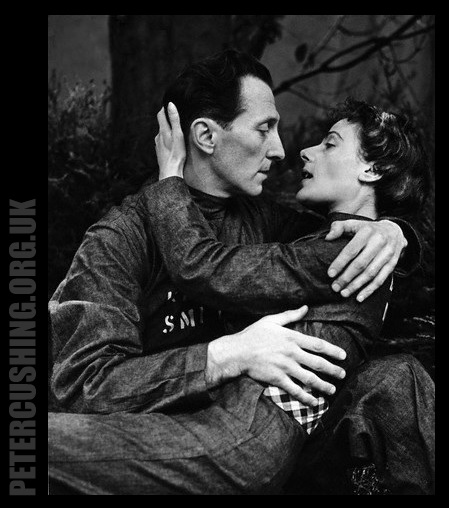
Definitely one of the harder Cushing outings to track down (the DVD is unavailable on these English shores), Nineteen Eighty-Four is Nigel Kneale’s adaptation of George Orwell’s ludicrously influential novel/ sermon and serves as a solid launchpad for Cushing’s megastardom alongside Donald “annihilation” Pleasance (I’ve yet to popularise this nickname but am working on it), Andre Morell and Yvonne Mitchell. As a work of fiction it’s astounding still, in spite of the foundation anachronism of a potential (possible, even) future so steeped in past technology it almost renders it rather silly.


Somewhat wiped out after its relentless grimmery, it was with open arms (and eyes and ears and brain) that I welcomed:
THE ABOMINABLE SNOWMAN (1957)

Cushing opens the picture in a Himalayan village, making plans to embark on an expedition to find the fabled Yeti against the wishes of the village elder, his typically passive and subservient wife (named Helen after Cushing’s own and on his insistence) before a gaggle of big, smoking Americans show up and the jolly lot of them set off across some very convincingly shot snowy wastes. This is helped tremendously by Val Guest’s direction (in black and white), and no doubt by a handsome budget which facilitates the abundance of aerial shots and an absolutely gorgeous set for the village (later reused for Christopher Lee’s Fu Manchu films).


Nigel Kneale returns to script the film and provides a typically thoughtful work in which the nature of monstrosity is questioned. Indeed, Kneale is clever not to paint the Yeti (who is not glimpsed in full and only appears significantly in the final five minutes of the film) as a monster: those deaths they are responsible for can be attributed to fear and insanity (not unrealistic reactions to humongous snowbeasts from hell, one should think). The film moves along at a brisk pace and the tensions between the Englishmen and the great big Americans (led by Forrest Tucker who receives top billing to placate Hammer’s US backers and wind the rest of us up, frankly) provide much of the entertainment, so much so in fact that when the beast’s disembodied hand first appears it damn near derails the picture, not unlike the first time Dave Prowse is glimpse in Hammer’s largely unloved Horror Of Frankenstein.

As I discovered later (again and again), for all the studio’s qualities they had a real weakness for underwhelming monster makeup. Anyway, there’s not much more to say about it other than that Michael Brill (whose name is self-descriptive) plays a character that seems very much like the male equivalent of those unfortunate ladies whose sultry charms fell victim to The Count’s incisors in the studio’s Dracula films, and that the whole thing is hardly memorable but a really effective way to pass an hour and a half. Recommended.
THE HOUND OF THE BASKERVILLES (1959)

And now, the confession: BBC’s Sherlock has been to date my only experience with Mr. Holmes outside of this Hammer offering from 1959. Given how much I enjoyed both (and the opportunity to compare versions of a story so vastly different as those from each version) I imagine I’ll make up for it in the future. For now, though, it is only fit to wax verbal on that moor-bound mutt, his misdeeds, and Cushing’s debut as the deerstalker-bedecked ‘tec who was reportedly first done justice regarding his general jerkery in this adaptation of Conan Doyle’s famous (seriously, it’s like rilly rilly famous guys) novel.

What I love about Peter Cushing is the extent to which I’ll compare his performances when watching him, which is TO ZERO EXTENT. I can readily accept him as two generations of Van Helsing, Moff Tarkin and Sherlock Holmes without ever thinking of another of his often iconic roles. To see an established actor slip so easily into an already occupied role and both play it on his own terms and not let it define his career is a treat, a small joy. If I’ve not made it clear already, I LOVE Peter Cushing. When he says “I’ve hurt my leg, I’m cold and I’m hungry” after appearing perched atop a carriage near the end of this film I actually whooped. I made a sound not unlike that of a wild animal in appreciation of his gentle talent. He’s a winner at everything.

So, gush dealt, how fared the film? Well, for a story so famous (as we’ve covered) I was surprised to see how Hammerised it was. I mean, this film has one of the most brazenly Hammer openings possible: big brass music, an unconvincing backdrop and a roll call of the usual suspects (Asher, Keys, Hinds, Bernard, Lee, Morell and Sir Peter, of course). The first scene presents Sir Hugo Baskerville (or ‘of the Baskervilles’, as I always want to type) and he’s a real scumbag, a truly delicious screen villain courtesy of David Oxley. Indeed, he’s such a royal prick that I was sorry to see him go (but not before delivering one of the most dramatic stabbings in film history, unleashing his own pack of cute little Beaglehounds and responding to a twice-dubbed scream that nearly steals the film- it’s THAT good) though his death is fairly pivotal to the story so I can scarcely complain.

Still, for all its Hammer fluster it quickly becomes a rather fusty, talky picture where old, nice men devote a LOT of screen time to saying clever things, being civil and getting murdered. Cushing, who was reportedly fond of props (or ‘prop-fond’, as I’ll be saying from here on out) is well served in 221b Baker Street and just about every other new location he visits, fiddling with pictures and his oft’ present pipe. One wonders just what he was off fondling for the majority of the middle third of the film during which he is absent as Watson (Morell again, this time praising Cushing rather than subjecting him to torture) traipses about Dartmoor, and his Holmes is such a commanding screen jerk (an endearing jerk but a jerk unquestionably) that the film nearly stalls without him.

When he reappears though it only heightened my appreciation, and before long he’s embroiled in some action (I’m telling you, Cushing just loves wrecking about the place), shooting at the world’s biggest dog with the world’s tiniest gun (but such a gentlemanly weapon). The dog’s mask is a bit of a stumbling block, as is Lee’s performance which is oddly stiff, despite his all-commanding presence, and forgive the apparent blasphemy of that statement as I’m sure his decision to play Henry (Of The Baskervilles) was entirely justified.

Anywhat, if it’s a Cushing Ruckuss, an engaging lead role and a film which boasts the phrase “a two-pipe problem”, Baskerhounds is for you.
THE GORGON (1964)

Right, let’s be explosive: The Gorgon is AWESOME. Juvenile as that may sound, it truly is an awesome film, and I enjoyed every moment of it. Joining Mr. Cushing is the atypical Hammer Girl Barbara Shelley, arguably my favourite actress and a sure-fire presence to ground a film in a sense of decency.

As always, Sir Pete is introduced with little fanfare but sports the greatest facial hair of his career. He’s involved in local shenanigans and a good few Hammer Staples crop up – there’s a Paul AND a Bruno, as well as typically jerky locals and a pervading communal fear. The Gorgon herself lives in a matte painting of a castle and spends her nights turning the locals into stone in action lifted straight from Greek mythology, something that fits surprisingly well within Hammer’s Eurocentric literary canon.

Cushing gets involved in a love triangle and adds jealousy and loathing to his bow, but as soon as mustachioed Christopher Lee shows up it’s hard to take your eyes off him in one of his most scenery-wolfing performances. Terence Fisher directs with style, dropping his usual tricks throughout the picture as well as often subtly forecasting events for the benefit of the eagle-eyed. The Gorgon was released on DVD in 2010 and is available for next to nothing- you have no excuse. Own it.

THE LEGEND OF THE SEVEN GOLDEN VAMPIRES (1974)

What does it say about this movie that in describing it to friends I’ve called it all manner of things from Legend Of The Seven Jumping Vampires to Legend Of The Seven Dancing Vampires, bringing with it as it does such a state of confusion because, frankly, it. Is. Bonkers.

It messed with me so much that that opening sentence began as a question and ended as a paragraph. I can’t even write coherently about a movie in which common sense and a respect for the human mind are banished to sunny China so’s some terribly designed vampires (dancing, jumping, golden) can feast on them. That’s right, Cushettes (that’s your new nickname, readers – you’re the Cushettes) – the vampires in this brain-drain feed on CONCEPTS. This is one wacky film, a collaboration between Hammer and the Shaw Brothers in which Sir Pete, lecturing IN ENGLISH in China is recruited by one of seven brothers (though not the same seven brothers for whom the courting of seven wives was, oh, you see where I’m going with that...) to hunt down the aforementioned crap, high-kicking kung-fu fangbangers thanks to the promise that good old Count D is involved and he can give him a jolly good wooden stabbing, as he is so very happy to do picture after picture (and indeed, upon continent after continent).

“Dracula” in this film is played with zero credibility for a couple minutes by John-Forbes Robinson, whose take on the famous bloodsucker is so unbearably (but not out-of-place-ingly) hammy that it is no small relief when, for no reason, he infuses his spirit into that of the Asian vamps’ leader, though he does reappear in the last reel to get his just desserts and a smiting from our Van Helsing. Forbes-Robinson’s brevity of screentime is a blessing because his very presence feels out of place, even in this film starring a 61-year old monster hunter in turn of the century China.

Cushing cannot be faulted. I know I’m writing for a Peter Cushing fan site but such comments need never go unstated. Even here, his exposition is easy to swallow, and as ever he makes that extra effort to best serve the local pronunciation whenever he can. He’s fighting not just vampires but disbelief, as he often does, but metaphysical commentary aside and in spite of his age, the Cushing Ruckuss is present and accounted for, and he can be spotted duelling and dealing death when he’s not DIVING INTO FIRE amidst nigh-on endless scenes of gushing blood, scrapping swordsmen and some of the very best dubbing of screams I’ve ever heard. You’ll also get to see a vampire melt like at the end of 1958’s Dracula, but it’s nowhere as effective and as special effects go, laughably transparent.

Roy Ward Baker (of Quatermass And The Pit) handles his portion of the direction capably (though James Bernard’s use of his Dracula score during Forbes-Robinson’s scenes is wholly unforgivable), but to be honest this is not a film that deserves (or invites) such stoic criticism. It’s great fun, and in that, it deserves viewing....
I’m not sure what I’ll be watching for next Friday, but I’ll be limiting myself to three films as like any partwork magazine you only get twice as much for the first two instalments. I’ve no idea how that applies to this, but it seems a decent enough reason not to burn myself out on Cushing pics. If you missed last week's piece, you can find it HERE! 'Til next time , Cushettes.
REVIEWS: PAUL MCNAMEE
PAUL'S BLOG: CLICK HERE!
IMAGES: MARCUS BROOKS
REVIEWS: PAUL MCNAMEE
PAUL'S BLOG: CLICK HERE!
IMAGES: MARCUS BROOKS
Subscribe to:
Posts (Atom)
